
A Lost Scene from In Leicester Fields
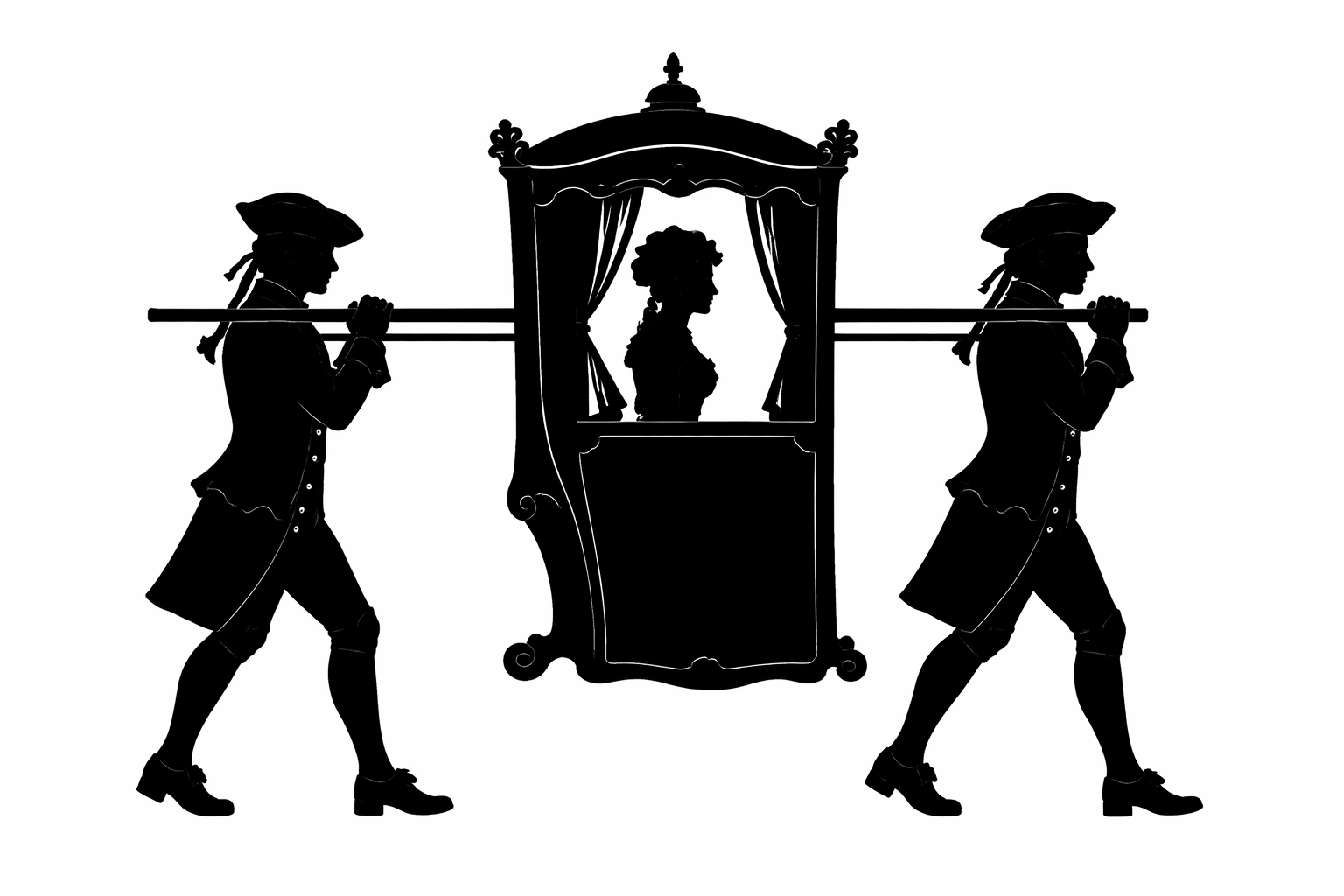
Sadly, some favourite scenes get lost in the editing process. In chapter one of In Leicester Fields we glimpse two chairmen, 18th century cabbies who hoisted their fares around town in a four-handled wooden box. As one of these men would become an artist's model later in the narrative, I had originally allowed these colourful characters a storyline of their own...
I did not come to London to spend each and every day with a view of O’Brien’s fat head and a daily earful of his brainless blather. Sure, the fellow is built like an ox and he has the thick head to match. Only today, as we were taking a fare from The Royal Mews to Buckingham House, (which is a fair old hump and so he had plenty of time to consider this better), he says to me, as he does much too often, “Riordan? Riorden? Are you still there Mr Riordan?”
No doubt O’Brien considers his opening gambit a clever piece of repartee, but there are times when I wonder if he thinks I might have gone off for refreshment and left him humping the box on his own. Without turning to establish my presence, O’Brien says, “your man in the box there?” I await whatever meaningful observation O’Brien might have to share with me concerning the rustic gent lately confined in our conveyance. “Never been in London in his life. He told me so himself.”
“There’s a thing, now,” I say, or rather I have to shout it above the noise of the self-styled musicians who are kicking up a dreadful racket for the benefit of the coach passengers arriving tired and famished at Charing Cross.
“Doesn’t know St James from St Giles, poor fellow,” O’Brien says.
“A fellow should know that,” I concede.
“So what I’m saying, Mr Riorden, is that it would be nothing but hospitable to show him just a bit of the town.”
“And which bit did you have in mind?” I call.
O’Brien bellows a ‘by your leave!’ and we quicken our strides, knocking the portmanteau from the hand of an elderly widow as we heft the box and our fare over the cobbles and kennels towards the Strand, where, instead of proceeding towards the given address, O’Brien turns us left and we begin to climb up towards Covent Garden.
“A man’s not seen London,” O’Brien calls, “until he’s seen the Covent Garden ladies.”
“Just the once around the piazza,” I say, “then we’ll take him where he wants to go. He’ll smell a rat otherwise.”
“And not see Newgate? Or the lions in the Tower? That would be a terrible shame.”
He’s blathering again. After mounting the hill, my arms are half-pulled from their sockets and I doubt his feel better. It’s towards the end of a long day and already we have lumped that fecking box from Limehouse to Chelsea and places inbetween. But O’Brien wants a couple more shillings, a little extra to give the tapster at the Fox and Seven Stars, where he does his drinking when the day is done, and we are, too. And so, without so much as a moment to rest the chair and wipe my brow, we are off again, around the square past the church and the theatre, the tavern where drinkers are catching the last of the afternoon sun, weaving among the costermongers with their barrows heaped with day-old fruit and vegetables and all the time, O’Brien calling out halloos to the girls who walk the square. Then it’s back down to the Strand we go, our fare about doubled and our man in the box none the wiser. When we’re on level ground and his stride is matching mine, we go smoothly and quickly, even if it is O’Brien who avoids the filthy puddles and me that has to splash through them.
It’s a living, I’m thinking, and not such a bad one at that, even if it was never the thing I thought I would do when I came over the sea from Donegal. There’s the clothes we all wear. The blue kersey coat and the black knee breeches, the white stockings and buckled shoes. Now a man might look worse than that. And there’s no shortage of employment, so long as you beat the other fellow to the fare, and the body is exercised, even if the mind is not. It brings in enough for a man to keep his place in his lodging house and to take a pot of ale and a pipe in the evening. That is to say, it suffices for Mr Conor O’Brien.
Myself, I keep a neat room up two pair of stairs in the Dials, and I prefer a glass of wine to the beer or the gin that’s the drink of choice in these parts. I go to Drury Lane and sometimes to The King’s Theatre in the Haymarket. Afterwards, I might visit a chophouse where I will take a glass and something to eat. I am not a whit like O’Brien, you will observe. My face is much better known, for one thing.
Perhaps you know it yourself. If you have access to the better houses in this town, then you might indeed have seen me, though I would not have returned the honour. It’s a fact that I am to be seen in the best of places. Peers of the English realm have looked full in my face at Marlborough, and I have been admired at Hampton Court Palace and half way up the stairs at Buckingham House. If I tell you that I have often been seen at the Summer Exhibition of the the Royal Academy, you will discover my riddle.
In short, I am the muse of artists. I have stood model for pictures that are now much admired. Stripped of my shirt, I have become Hercules, Samson and Androcles with the lion or was it that Achilles? Some fellow in a strange hat, anyway. I have been the favoured male for some of the most notable artists in town. I’d like to think I was selected for my brains and my charm, but the plain truth of the matter is that I have the body the painters want. It’s not like O’Brien’s, who as I say, only needs hitching to a plough to be mistaken for an ox.
But the fact of the matter is that no-one’s a chairman very long before he sees a difference in his physique. Shoulders, biceps, wrists, thighs, all grow bigger, the muscles firmer. And what I have found, is that there’s a call for fellows with this kind of a build. The artists love the chairmen, and the porters, too. We’re built like men, not like the powederpuff blow-me-downs you see, all dainty in their scented wigs and lace. Much good they would be, as Atlas or Poseidon.
On Sundays, when O’Brien will not work, (because he is a righteous Roman Catholic, he says, but actually is hung-over from the Saturday night before), I am quite often up early and heading off to one or other of the artist fellows who are in need of a strapping chap like me. I like the occupation, sporadic as it is. Ah, but painters are slow fellows and I much regret that there’s not enough work for me to drop my end of the box and leave O’Brien to explain it to my last fare.